
Untrodden Paths, Unfamiliar Landscapes: A Travelogue of America
2026-06-05
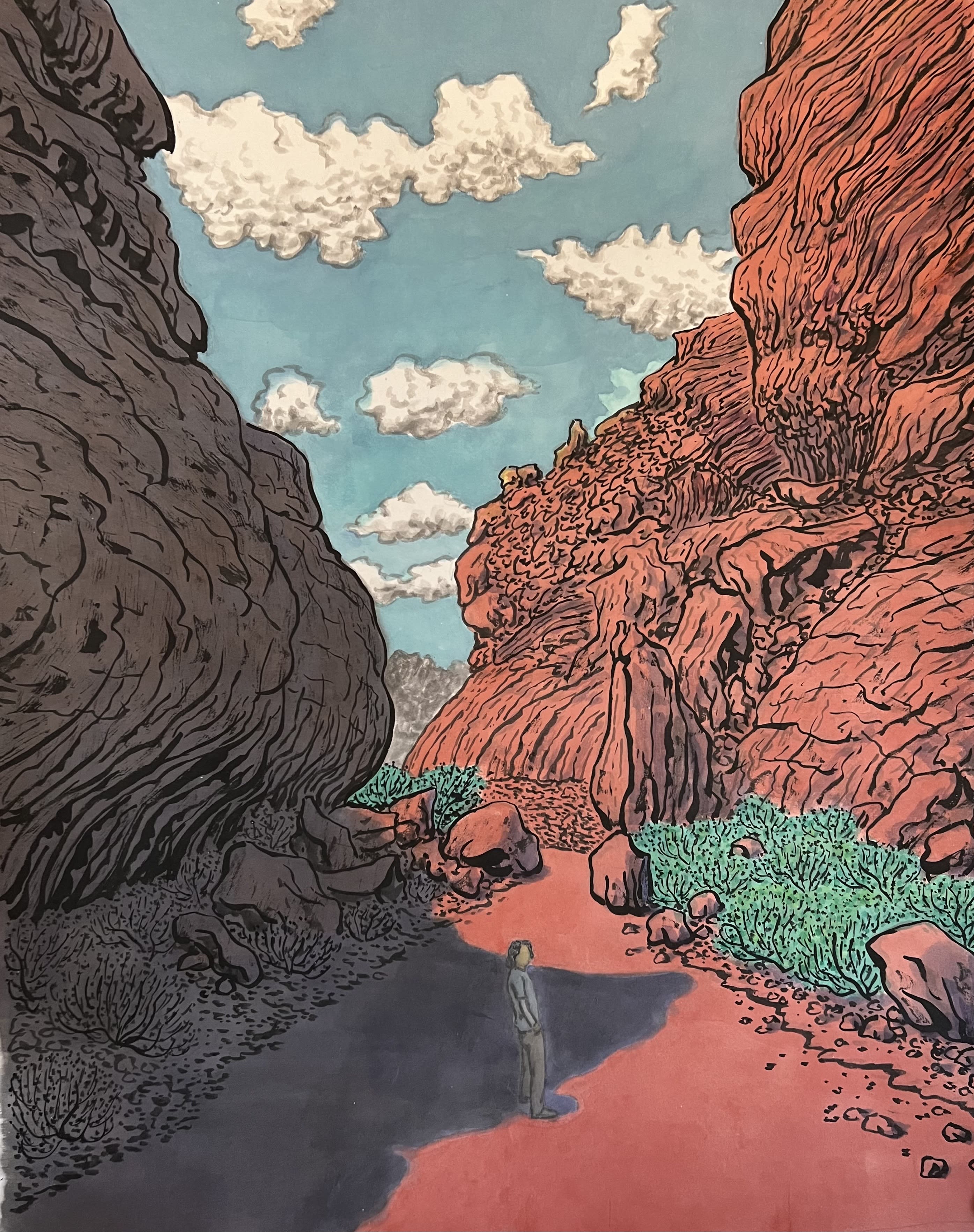
가보지 않은 길, 낯선 풍경: 미국 여행기 (Unbeaten Paths, Unfamiliar Landscapes)
미국의 대자연을 마주하며 나의 예술적 목적은 명확하다. 한지 고유의 원초적 특성인 '스며듬'을 이용해 채색하고, 동양에서 가장 오래된 화구인 붓의 아날로그적 기능인 '그리기'를 통해 내가 목격한 풍경의 원형을 최대한 존중하는 것이다. 그리고 그 안에서 내가 구축해 온 회화적 구조를 바탕으로 나만의 예술 세계를 펼쳐나가는 것이다.
내가 미국의 풍경을 그리는 것은 탐험가가 미지의 세계를 개척하기 위해 낯선 곳으로 모험을 떠나는 것과 같다. 나만의 방법론으로 전 세계의 다양한 풍경을 한지 위에 기록해 나가는 것, 그것은 화가로서 내 삶의 중요한 이정표 중 하나다.
엄밀히 따지면 나는 내 그리기 방식에 풍경을 억지로 맞추지 않는다. 오히려 마주한 풍경에 맞춰 나의 방법론을 끊임없이 변화시키고 유연하게 바꿔나가는 것이 내 작업의 방향성이다. 낯선 자연을 온전히 담아내기 위해 나는 그 장소에 걸맞은 새로운 선과 점, 독창적인 구도와 색채를 부단히 찾아내야만 한다. 궁극적으로 나는 이 치열한 탐색의 과정이 늘 흥미롭고 즐겁다.
거대한 협곡의 충격: 브라이스 캐년 (Bryce Canyon) 브라이스 캐년을 처음 마주했을 때 머릿속에 스친 첫인상은 ‘와, 멋지다’가 아니었다. ‘이 어마어마한 것을 대체 어떻게 그림으로 그려야 하지?’라는 다소 황당한 압도감이었다. 화폭에 도저히 담아낼 수 없을 것만 같은 시각적 충격, 기괴하면서도 신비스럽고 아름다운 풍경이 눈앞에 펼쳐져 있었다. 실제로 나는 처음 그곳에 머무는 하루 동안, 그저 거대한 협곡을 보고 또 바라보며 쳐다만 볼 뿐이었다. 계곡 곳곳에 흩어진 뷰포인트를 찾아다니며 끊임없이 스스로에게 질문을 던졌다. ‘어떻게든 이 압도적인 풍경을 나만의 회화적 패턴으로 해석해 내야만 한다.’
두 번째로 브라이스 캐년을 방문했을 때야 비로소 그것을 그림으로 풀어나갈 방법들이 어렴풋이 보이기 시작했다. 현장에서 내가 집중한 것은 바위들이 거대한 군상처럼 서 있거나 붉은 불꽃처럼 타오르는 형상을 드로잉을 통해 몸으로 익히고, 눈으로 관찰하며 확인하는 일이었다. 사흘간 그곳에 머물며 해 질 녘의 아스라한 풍경과 새벽의 장엄한 일출을 목격했다. 빛의 미세한 변화에 따라 시시각각 다르게 채색되는 브라이스 캐년의 신비로운 색감을 내 온몸과 기억 세포에 깊이 각인시켰다.
압도적인 바위산의 품격: 자이온 캐년 (Zion Canyon) 자이온 캐년은 내가 수십 년간 스케치하러 다녔던 한국의 정선과 영월의 절벽 풍경을 수백 배쯤 키워놓은 듯한, 그야말로 어마어마한 암산과 절벽의 연속이었다. 거대한 수직의 절벽을 마주했을 때 나는 그저 감탄사만 연발할 뿐, 차마 스케치북을 꺼내 들 엄두조차 내지 못했다. 그러나 신비스러운 색을 품은 자이온 캐년의 바위산들은 하나하나 고유한 품격과 독특한 조형미를 지니고 있었다. 조형적·디자인적으로도 대단히 세련된 대자연의 극치였다.
두 번째 방문에서는 나흘간 머물며 본격적으로 스케치 작업을 다녔다. 아침 일찍 나가 트레킹을 하며 선을 따고, 낮에는 숙소에서 작업을 이어간 뒤, 해 질 녘이면 다시 밖으로 나가 석양이 비치며 붉게 변해가는 암산의 색채를 감상했다. 그 시간은 화가로서 형용할 수 없이 행복한 순간이었다. 특히 멀리서 바라만 보던 바위산의 깊은 주름을 따라 직접 걸으며 산책했던 경험은, 자이온 캐년 암산이 지닌 구조적 특질을 깊이 이해하는 데 결정적인 도움이 되었다.
생명이 숨 쉬는 사막: 네바다와 조수아 트리 (Nevada & Joshua Tree) 네바다의 사막은 죽은 땅이 아니라 온갖 생명체들이 역동적으로 살아가는 생명의 보고(寶庫)였다. 나는 미스테리 렌치 레지던시에 머무는 동안 이른 아침마다 사막의 숲으로 스케치를 나갔다. 해가 뜨기 전의 사막은 시원하고 상쾌한 바람이 불어와 정신을 맑게 깨워주었다. 마치 내 영혼을 깨끗이 씻어주는 '영혼의 목욕탕' 같았다. 스케치에 몰두하는 동안 주변의 도마뱀, 토끼, 다람쥐, 작은 곤충들이 다가왔고, 조수아 트리에 앉아 끊임없이 구애의 노래를 부르는 검은 새(머리에 붉고 긴 깃털이 있는 새)가 나의 다정한 벗이 되어주었다. 사막은 결코 외롭지 않은 공간이었다.
네바다의 아비 꽈메 내셔널 모뉴멘트(Avi Kwa Ame National Monument)는 당시 보호구역으로 지정된 지 얼마 되지 않은 태고의 자연이었다. 이 사막에는 수백 년 된 조수아 트리가 끝없이 펼쳐진 거대한 숲이 있다. 그곳에는 오랜 세월을 버티고 말라 죽은 고목과 10미터에 달하는 거목, 그리고 이제 갓 태어난 듯한 어린 조수아 트리가 경이로운 군락을 이루고 있었다. 3~4년씩 가뭄이 이어지다가 어쩌다 한 번 비가 내리는 혹독한 환경 속에서, 이 나무들은 물 한 모금 없이 몇 년 동안 죽음과 같은 고비를 이겨내야 비로소 단비에 목을 축일 수 있다고 한다. 수많은 나무들이 가뭄을 이기지 못하고 쓰러지지만, 그 자리에 당당히 살아남은 거대한 조수아 트리들은 그 자체로 위대한 생명의 상징이었다. 500년에서 1000년에 이르는 세월 동안 그 모진 가뭄을 이겨내고 거대한 숲을 이룬 풍경 앞에서 나는 깊은 경외감을 느꼈다.
가장 큰 심경의 변화: 캐피톨 리프 (Capitol Reef) 유타주에 위치한 캐피톨 리프 국립공원은 바위산과 협곡이 정교하게 어우러진 대단히 아름다운 곳이다. 왜 이제야 국립공원으로 지정되었는지 의아할 정도였다. 이 공원은 평균 고도가 2,400미터에 달해 조금만 걸어도 숨이 가빠오는 고지대였기에 공기의 질감 자체가 달랐다. 머무는 동안 진눈개비가 날려 두꺼운 옷을 껴입어야 할 정도로 날씨가 변덕스러웠지만, 오염되지 않은 맑은 공기 덕분에 깜깜한 밤하늘을 가득 수놓은 수많은 별을 목격할 수 있어 행복했다.
특히 캐피톨 리프의 협곡과 바위산은 내 회화 세계에 가장 큰 심경의 변화를 가져다준 특별한 장소다. 4월 레지던시 프로그램으로 엔트라다 인스티튜트에 머물며 만난 이곳의 절벽들은, 거대한 규모 속에 지극히 섬세하고 정교한 디테일을 동시에 품고 있었다. 나는 이 독특한 절벽을 화면에 담아내기 위해 곡선의 자유로운 선과 필법(筆法)을 도입했다. 그것은 완전한 자유 드로잉이자, 화면 위에서 마치 춤을 추듯 선을 긋는 황홀한 행위였다. 이곳에서의 작업은 내가 미국의 대자연을 앞으로 어떻게 해석하고 그려나갈지에 대한 가장 명확한 단초를 던져준 이정표 같은 경험이었다.
길 위에서 발견한 영감: 모하비 사막과 빨간 창고 LA에서 라스베가스로 가기 위해서는 모하비 사막을 가로질러 5시간 넘게 운전을 해야 한다. 4월의 유타 레지던시를 향해 그 길을 지나갈 때, 거대한 먹구름들이 여기저기 비를 뿌리며 이동하는 신비로운 광경을 목격했다. 가끔 우리가 그 비구름 한가운데를 관통할 때면 순식간에 폭우가 쏟아져 앞이 보이지 않다가도, 그 구간을 벗어나면 다시 햇살이 쨍쨍하게 내리쬐는 화창한 현실로 돌아오기를 반복했다. 신비로운 자연의 장난 같았다. 특히 지난겨울에 눈이 많이 내린 덕분인지, 모하비 사막은 믿을 수 없을 정도로 샛노란 야생화로 가득 뒤덮여 있었다. 노란색과 초록색이 어우러진 사막의 봄 풍경은 그 자체로 거대한 캔버스였다.
네바다의 사막이나 유타의 들판을 달리다 보면, 광활한 대지 위에 빨간 박공지붕의 창고와 사각형 컨테이너들이 툭툭 던져져 있는 모습이 무척 인상적이었다. 이 이국적이고 뜬금없는 붉은 오브제들은 애리조나를 여행할 때도 자주 목격했던 장면이다. 나는 이 사막 풍경 속 빨간 집과 컨테이너를 나만의 예술적 시그니처(Signature)로 사용하기 위해 에스키스(초안 드로잉)와 메모를 철저히 남겨두었다. 끝없는 사막에 덩그러니 놓인 집과 창고는 그곳에 인간이 존재한다는 온기의 표시이자, 뜨거운 햇볕을 피해 쉴 수 있는 소중한 오아시스 같은 공간이라는 생각이 들었기 때문이다.
여행이 이토록 좋은 이유는 세상의 모든 존재가 예술적 아이디어를 위해 존재하는 것처럼 다가오기 때문이다. 새로운 것에 호기심을 갖는 화가로서의 감각이 깨어나서일까. 길 위에서 만나는 모든 것이 새롭고, 여전히 궁금하다./ 2024 추니박
English
Unbeaten Paths, Unfamiliar Landscapes: A Journey Through America
Confronting the American Wilderness My artistic purpose is defined by clear intentions: to color by harnessing the intrinsic, primeval quality of hanji (traditional Korean mulberry paper)—its capacity for absorption—and to render my subjects using the analog function of the brush, the oldest painting tool in the East. In doing so, I deeply respect the original archetype of the landscapes I witness, while expanding my own artistic world upon the pictorial structures I have built over a lifetime.
For me, painting the American landscape is akin to an explorer venturing into uncharted territories, braving the unknown to open up a new world. To record the world’s diverse landscapes onto hanji through my own artistic methodology is one of the definitive milestones of my life as a painter.
Strictly speaking, I do not force the landscape to conform to my existing method of painting. Rather, the core direction of my work lies in continuously adapting and shifting my methodology to fit the landscape before me. To capture unfamiliar nature, I must labor to discover new lines, dots, compositions, and color palettes that resonate with that specific environment. Ultimately, I find this fierce process of aesthetic exploration endlessly intriguing and exhilarating.
The Shock of the Great Canyons: Bryce Canyon When I first stood before Bryce Canyon, the first impression that flashed through my mind was not a simple exclamation of "Wow, how beautiful!" Instead, it was a somewhat bewildering sense of artistic overwhelmingness: "How on earth am I going to translate this into a painting?" The scene was so overwhelmingly shocking, grotesque, mysterious, and sublime that it felt almost impossible to capture on a canvas. In fact, during my first full day there, I did nothing but gaze at the monumental canyon, staring at it continuously. As I wandered from one viewpoint to another scattered across the valley, I kept asking myself the same question: "Somehow, I must discover my own pictorial pattern to interpret this colossal landscape."
It was only during my second visit to Bryce Canyon that I began to envision a concrete way to resolve the landscape through my brush. Standing on-site once again, my task was to internalize through drawing—and to verify through deep visual observation—whether those rock formations truly stood like dense crowds of human figures or flared up like soaring tongues of fire. Staying there for three days, I witnessed both the twilight hues fading over Bryce Canyon and the majestic sunrise at dawn. I absorbed with my entire body and memory the magnificent spectrum of colors that shifted fluidly depending on the subtle nuances of light.
The Dignity of the Colossal Mountains: Zion Canyon Zion Canyon was an utterly overwhelming landscape of monumental rocky mountains and sheer cliffs—looking as if the cliffside landscapes of Jeongseon and Yeongwol in Korea, which I have visited for sketches for decades, had been magnified hundreds of times over. Confronted by these immense vertical walls of stone, I could only gasp in continuous admiration; I simply did not have the courage to pull out my sketchbook. Yet, these rocky peaks cradling mysterious colors possessed an innate dignity and a unique formal beauty. It was nature at its absolute finest, exhibiting a highly sophisticated sense of organic design.
During our second visit, we stayed for four days to immerse ourselves in sketching. We would head out early in the morning to trek and sketch, return to our lodging to work during the day, and venture out again at dusk to admire the breathtaking colors of the rocky peaks shifting under the setting sun. Those moments brought unadulterated joy to my soul as an artist. In particular, walking along the deep, undulating ridges of the stone mountains—which I had previously only admired from afar—was immensely helpful in deeply understanding the structural texture and characteristics of Zion Canyon.
A Desert Breathing with Life: Nevada and the Joshua Trees The Nevada desert was far from a barren wasteland; it was a sanctuary teeming with dynamic life. While staying at the Mystery Ranch residency, I walked into the desert woods early every morning to sketch. Before sunrise, the desert greeted me with a cool, refreshing breeze and crisp air that sharpened my senses, acting as a profound "bathhouse for the soul." While I was absorbed in sketching, the surrounding lizards, rabbits, squirrels, small insects, and wild birds became my companions. Among them was a black bird with a long, vibrant red crest perched on a Joshua Tree, singing its endless courtship song. In their presence, the desert never felt lonely.
Avi Kwa Ame National Monument in Nevada had been designated as a protected natural area just a year prior to my visit, preserving its primeval essence. This desert harbors a colossal, ancient forest densely filled with hundreds of years old Joshua Trees. Within it, withered skeletal trees, towering giants reaching nearly ten meters, and newborn saplings formed a wondrous, intergenerational community. In this arid terrain where droughts persist for three to four years before a single rainfall, these trees must endure years of near-death dehydration before they can finally quench their thirst with a precious drop of rain. While many trees perish unable to withstand the grueling droughts, the monumental Joshua Trees that stand resilient are, in themselves, great monuments of life. Facing a forest formed by countless trees that survived such harsh trials for 500 to nearly 1,000 years, I was overcome with profound reverence.
The Turning Point in My Artistry: Capitol Reef Capitol Reef National Park in Utah is an extraordinarily beautiful place, leaving a striking impression with its magnificent rocky peaks and deep canyons. It was surprising to realize it had only recently been elevated to a national park. Situated at an average elevation of around 2,400 meters, the air itself felt entirely different; even a light jog would leave me short of breath. During our stay, the weather was highly mercurial, occasionally blowing sleet and forcing us to bundle up in thick layers, yet the unpolluted, pristine air rewarded us with a night sky blanketed by an incredible multitude of stars.
More than anything, the canyons and rocky mountains of Capitol Reef brought about the most significant transformation in my inner artistic perspective. Staying at the Entrada Institute for an April residency program, I discovered that while these cliffs were colossally immense, they simultaneously harbored an exquisite, intricate delicacy. To capture these unique escarpments, I introduced a fluid, organic line work and free brush technique (pilbeop). It felt like total free-form drawing—marking lines on the paper as if performing a rhythmic dance. My work here served as a crucial turning point, providing the most definitive clue on how I would interpret and paint the vast landscapes of America moving forward.
Inspirations Found Along the Highway: The Mojave Desert and Red Sheds To travel from Los Angeles to Las Vegas, one must drive for about five hours across the expansive Mojave Desert. As we traversed this path in April for the Utah residency, we witnessed a surreal spectacle of massive rain clouds moving across the sky, pouring down sheets of rain in localized bursts. Whenever our car passed directly through one of these storm cells, a torrential downpour would instantly blind our vision; yet, the moment we cleared that section, we would immediately return to a bright, sun-drenched reality. It was a recurring, mystical theater of nature. Perhaps due to the heavy snowfall from the preceding winter, the Mojave Desert was miraculously carpeted with vibrant, golden wildflowers. The desert spring landscape, harmonizing brilliant yellows with fresh greens, was an absolute masterpiece.
Driving through the Nevada desert and the rural fields of Utah, I was profoundly struck by the sight of red gabled-roof sheds and rectangular shipping containers scattered abruptly across the vast, empty terrain. These unexpected red structures amidst the wilderness were a scene I had also encountered frequently while traveling through Arizona. I meticulously took notes and made esquisses (preliminary sketches) to adopt these red houses and square containers as my artistic signature within desert landscapes. I interpreted these isolated structures on the vast plains not merely as buildings, but as a warm testament to human presence—a precious oasis providing shelter and rest from the scorching sun.
The beauty of traveling lies in the realization that everything encountered seems to exist solely to offer creative inspiration. Perhaps it is because the artistic intuition that thrives on curiosity is fully awakened; everything I encounter on the road feels remarkably new, and I remain deeply curious about it all./Chuni Park